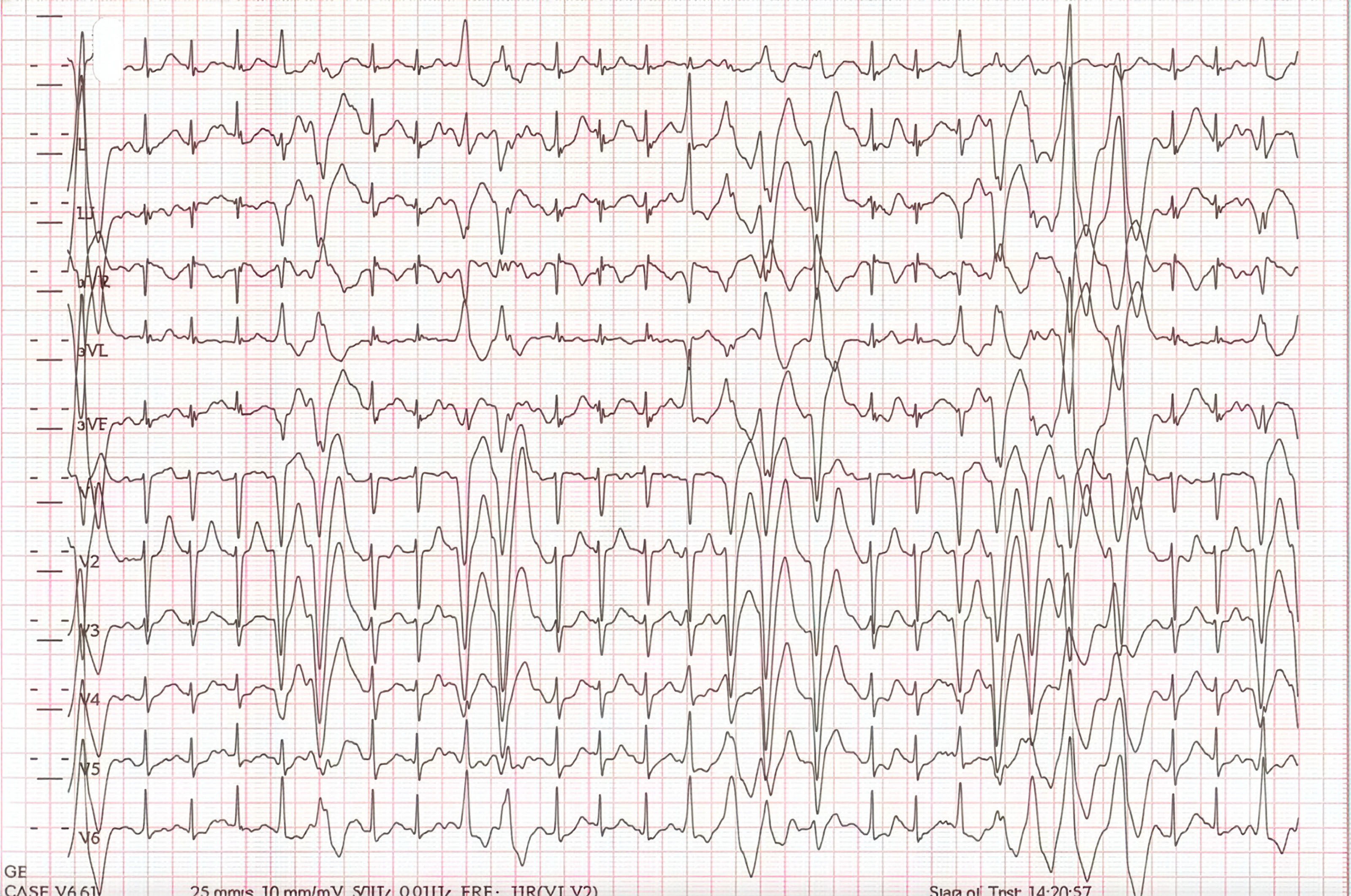
A 33-year-old man presented to the clinic with recurrent exertional syncope. The physical examination, baseline ECG, and bedside echocardiogram were unremarkable. An ECG during treadmill exercise test was attached below.
Which of the following statement is correct?
Choose the correct answer.
Correct Answer: A. The ECG findings are consistent with a diagnosis of Catecholaminergic Polymorphic Ventricular Tachycardia (CPVT)
In patients presenting with exertional syncope or ventricular arrhythmias in the setting of a structurally normal heart, the presence of exercise- or catecholamine-induced bidirectional PVCs (alternating 180° QRS axis beat-to-beat) and polymorphic VT is pathognomonic for CPVT
B is incorrect. While CPVT-related PVCs frequently exhibit a left bundle branch block (LBBB) pattern with an inferior axis (mimicking an RVOT origin), the concurrent presence of PVCs with a superior axis strongly supports a diagnosis of CPVT. The prognosis is significantly worse compared to that of idiopathic RVOT PVCs or VT, which are generally benign.
C is incorrect. Conducted beats demonstrate narrow QRS complexes at a regular rate, with no evidence of pre-excitation. Furthermore, the opposing axes of the wide QRS complexes are inconsistent with accessory pathway conduction.
D is incorrect. In CPVT, implantable cardioverter-defibrillator (ICD) shocks can trigger massive sympathetic surges, exacerbating calcium release via mutated RyR2 channels and triggering further DADs. This creates a highly dangerous "adrenergic storm" loop of recurrent VT and repeated shocks (ICD-induced proarrhythmia). Consequently, medical therapy—maximizing non-selective beta-blockers (e.g., nadolol) and adding flecainide—is primary. ICD placement is reserved as a Class IIa recommendation for patients with recurrent syncope or polymorphic/bidirectional VT despite optimal medical management.
E is incorrect. While verapamil (a non-dihydropyridine calcium channel blocker) is highly effective for verapamil-sensitive idiopathic left fascicular VT, it is not a first- or second-line agent for CPVT. The primary medical armamentarium for CPVT consists of non-selective beta-blockers, flecainide, and potentially sympathetic denervation (left cardiac sympathetic denervation [LCSD]).
More on CPVT: www.cardiologywiki.com
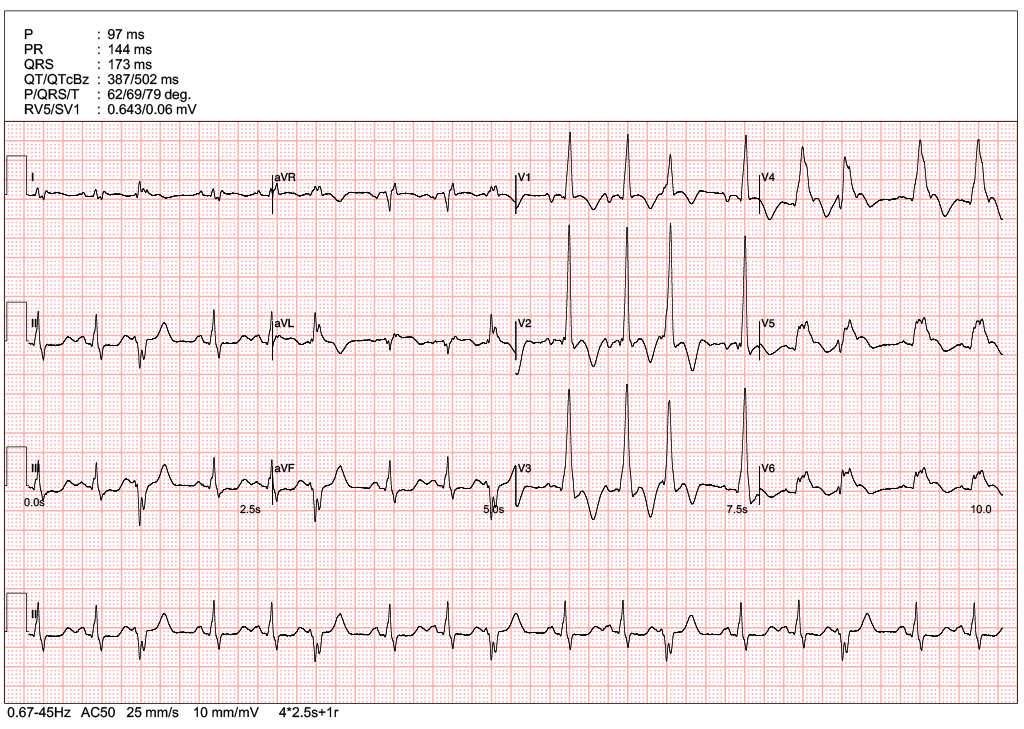
A 50-year-old man presented to the AED with acute chest pain, irregualr heart beats and dizziness today. His BP was 100/50 mmHg and SpO2 was 97% on room air.
Which of the following statement is correct?
Choose the correct answer.
The presenting ECG shows ST-segment elevation in leads V4-V6, accompanied by reciprocal ST-segment depressions in the inferior leads (II, III, aVF) on natively conducted QRS complexes.
The presence of the reciprocal changes significantly enhances diagnostic specificity for a true STEMI, as the widening of QRS complexes in V4-V6 may otherwise mask the diagnosis of ST elevation
egarding the rhythm, clearly discernible P waves are present throughout the tracing, conclusively ruling out atrial fibrillation. Additionally, the documented QT interval prolongation should be recognized as a common secondary consequence of acute, ischemic myocardial injury rather than being assumed to indicate a primary drug-induced or congenital long QT syndrome. While taking a detailed medication history is a necessary component of the clinical workup for QRS widening, this investigative step must not delay immediate activation of primary PCI.
The coronary angiogram showed an acute total occlusion of the mid-LAD, which is consistent with apical transmural ischemia, especially in the context of a rotated heart.
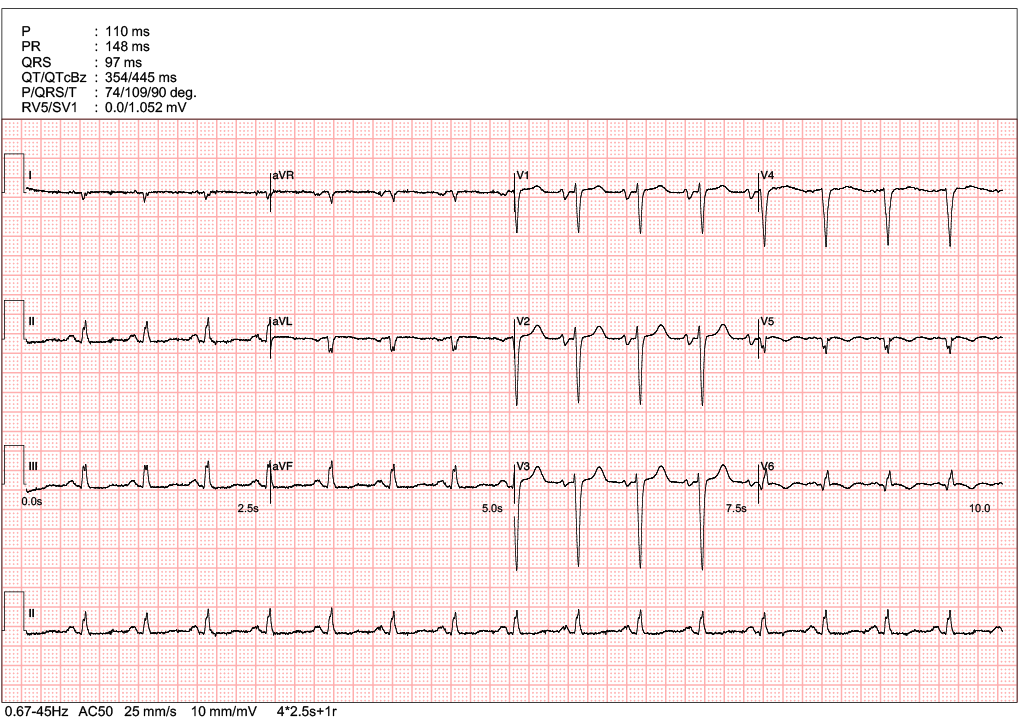
A post-PCI ECG is attached to evaluate for theexpected ST-segment resolution and confirm successful reperfusion.
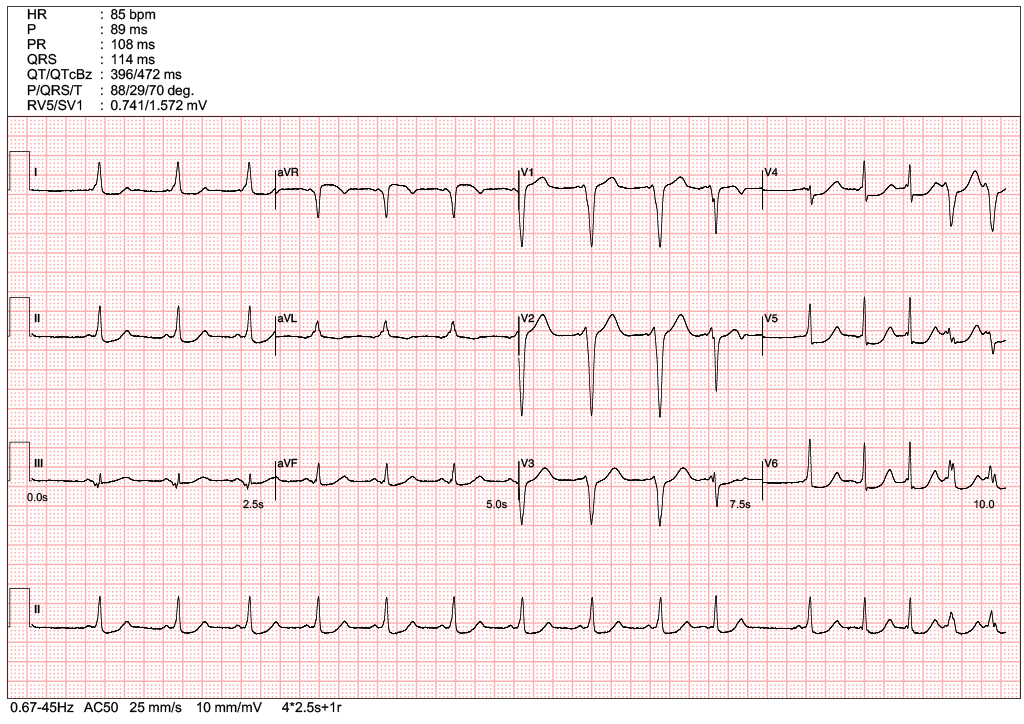
The wide complex tachycardia (WCT) was terminated following treatment in the AED. A follow-up ECG was then performed.
Which of the following stagement is correct?
Choose the correct answer.
D is the correct answer.
The patient has WPW and the previous wide complex tachycardia is likely an Antidromic Atrioventricular reentrant tachycardia (aAVRT).
This follow up ECG shows sinus rhythm, with occasional atrial ectopics, short PR interval with delta waves.
A is incorrect. No ST-segment elevation is observed on this ECG. The wide QRS complexes are preceded by distinct P waves with a short, consistent PR interval, suggesting a supraventricular origin with pathway conduction rather than a ventricular origin.
B is incorrect. The last two wide QRS complexes likely represent atrial ectopic beats demonstrating fully expressed pre-excitation. Careful examination reveals a preceding P wave in lead V5 prior to the QRS onset.
C is incorrect. Catheter ablation or Class IC antiarrhythmic drugs (in structurally normal heart) are preferred over long-term amiodarone therapy in patients with WPW syndrome.
E is incorrect. Findings suggest Wolff-Parkinson-White (WPW) syndrome with Antidromic AVRT (aAVRT), given that the wide complex tachycardia morphology is consistent with fully pre-excited conduction.
A 40-year-old female presented to the AED with palpitations and dizziness. She recently had a viral illness and had taken unknown over-the-counter medications. Her blood pressure was 110/50 mmHg.
Whichof the following stagement is correct?
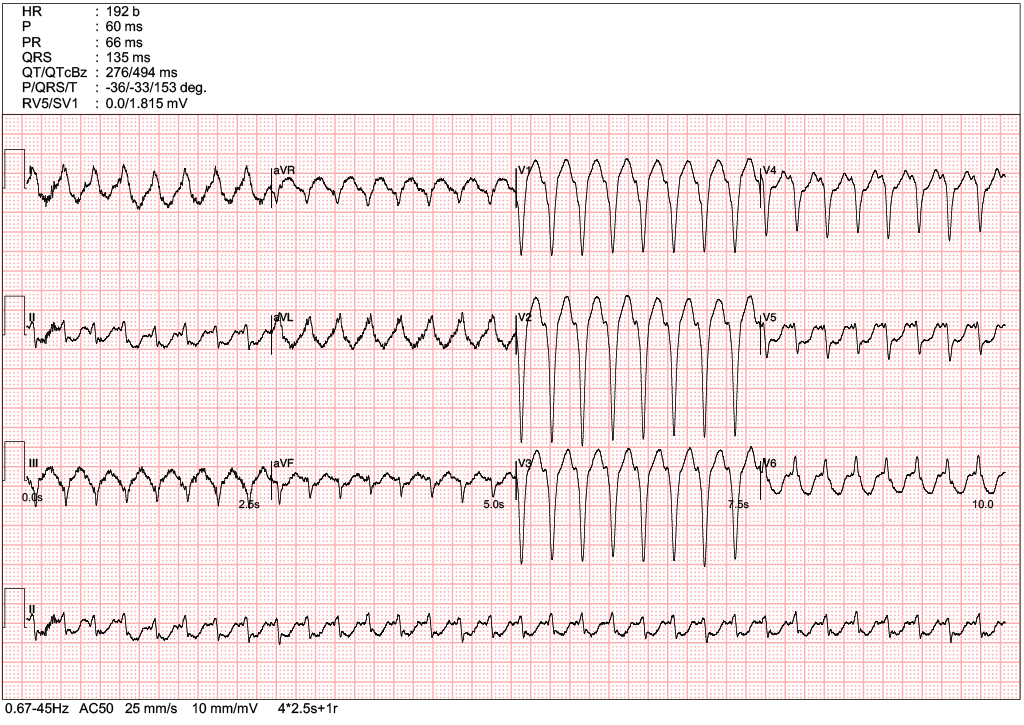
Choose the correct answer.
C is correct - Termination of tachycardia by Adenosine Triphosphate (ATP) could help differentiation of VT versus SVT.
Adenosine could help differentiate VT from SVT (most VT could not be terminated by adenosine). It is short acting and does not interfere with electrophysiology study.
A is incorrect. The diagnosis of VT is not confirmed. Direct current cardioversion could not help differentiate VT from SVT or AVRT. The patient is hemodynamically stable. There is no need for cardioversion.
B is incorrect. If SVT is considered more likely than VT, amiodarone should not be the first line of treatment due to its slow onset of action. Adenosine (or ATP) or AV nodal blocking agents like verapamil should be considered instead. Furthermore, amiodarone is contraindicated in Wolff-Parkinson-White (WPW) syndrome.
D is incorrect. The ST depression is due to repolarization change associated and not diagnostic of acute coronary syndrome in a 40 year old lady without chest pain.
E is incorrect. Sodium bicarbonate should be given in case of suspected tricyclic anti-depressant (TCA) or flecainide poisoning. The clinical history does not suggestive the use of TCA or flecainide.
Algorithms for differentiating SVT from VT) in wide complex tachycardia is available at https://www.cardiologywiki.com/