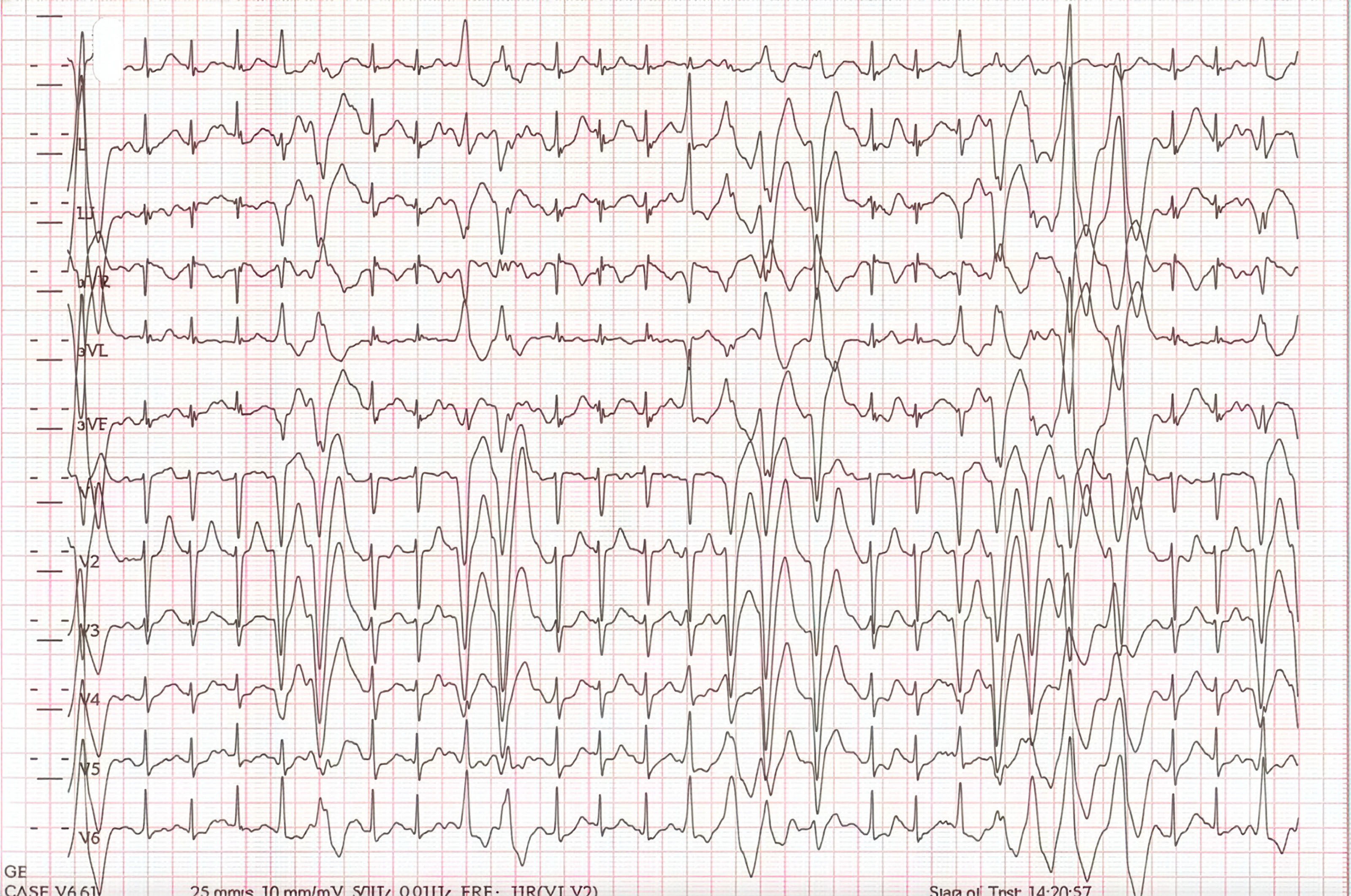
A 33-year-old man presented to the clinic with recurrent exertional syncope. The physical examination, baseline ECG, and bedside echocardiogram were unremarkable. An ECG during treadmill exercise test was attached below.
Which of the following statement is correct?
Choose the correct answer.
Correct Answer: A. The ECG findings are consistent with a diagnosis of Catecholaminergic Polymorphic Ventricular Tachycardia (CPVT)
In patients presenting with exertional syncope or ventricular arrhythmias in the setting of a structurally normal heart, the presence of exercise- or catecholamine-induced bidirectional PVCs (alternating 180° QRS axis beat-to-beat) and polymorphic VT is pathognomonic for CPVT
B is incorrect. While CPVT-related PVCs frequently exhibit a left bundle branch block (LBBB) pattern with an inferior axis (mimicking an RVOT origin), the concurrent presence of PVCs with a superior axis strongly supports a diagnosis of CPVT. The prognosis is significantly worse compared to that of idiopathic RVOT PVCs or VT, which are generally benign.
C is incorrect. Conducted beats demonstrate narrow QRS complexes at a regular rate, with no evidence of pre-excitation. Furthermore, the opposing axes of the wide QRS complexes are inconsistent with accessory pathway conduction.
D is incorrect. In CPVT, implantable cardioverter-defibrillator (ICD) shocks can trigger massive sympathetic surges, exacerbating calcium release via mutated RyR2 channels and triggering further DADs. This creates a highly dangerous "adrenergic storm" loop of recurrent VT and repeated shocks (ICD-induced proarrhythmia). Consequently, medical therapy—maximizing non-selective beta-blockers (e.g., nadolol) and adding flecainide—is primary. ICD placement is reserved as a Class IIa recommendation for patients with recurrent syncope or polymorphic/bidirectional VT despite optimal medical management.
E is incorrect. While verapamil (a non-dihydropyridine calcium channel blocker) is highly effective for verapamil-sensitive idiopathic left fascicular VT, it is not a first- or second-line agent for CPVT. The primary medical armamentarium for CPVT consists of non-selective beta-blockers, flecainide, and potentially sympathetic denervation (left cardiac sympathetic denervation [LCSD]).
More on CPVT: www.cardiologywiki.com