The wide complex tachycardia (WCT) was terminated following treatment in the AED. A follow-up ECG was then performed.
Which of the following stagement is correct?
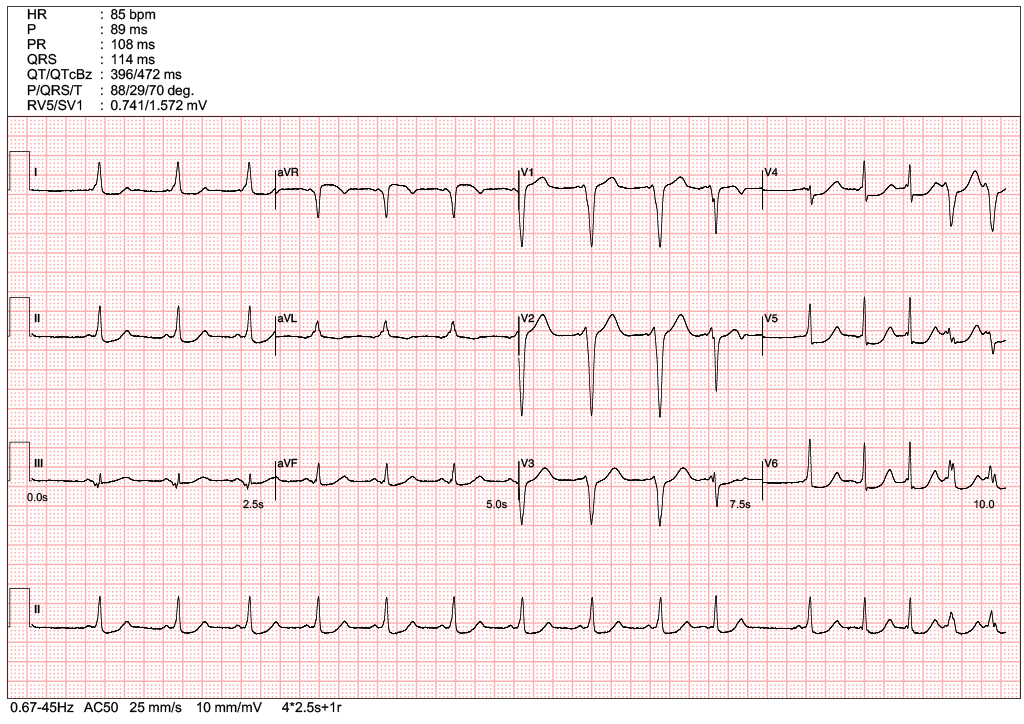
Choose the correct answer.
D is the correct answer.
The patient has WPW and the previous wide complex tachycardia is likely an Antidromic Atrioventricular reentrant tachycardia (aAVRT).
This follow up ECG shows sinus rhythm, with occasional atrial ectopics, short PR interval with delta waves.
A is incorrect. No ST-segment elevation is observed on this ECG. The wide QRS complexes are preceded by distinct P waves with a short, consistent PR interval, suggesting a supraventricular origin with pathway conduction rather than a ventricular origin.
B is incorrect. The last two wide QRS complexes likely represent atrial ectopic beats demonstrating fully expressed pre-excitation. Careful examination reveals a preceding P wave in lead V5 prior to the QRS onset.
C is incorrect. Catheter ablation or Class IC antiarrhythmic drugs (in structurally normal heart) are preferred over long-term amiodarone therapy in patients with WPW syndrome.
E is incorrect. Findings suggest Wolff-Parkinson-White (WPW) syndrome with Antidromic AVRT (aAVRT), given that the wide complex tachycardia morphology is consistent with fully pre-excited conduction.