A 62-year-old man with a history of diabetes mellitus and hypertension presented to the Emergency Department today with chest pain that started 3 hours ago; his symptoms have since completely resolved. Vital signs revealed BP 140/85 mmHg and SpO2 98% on room air.
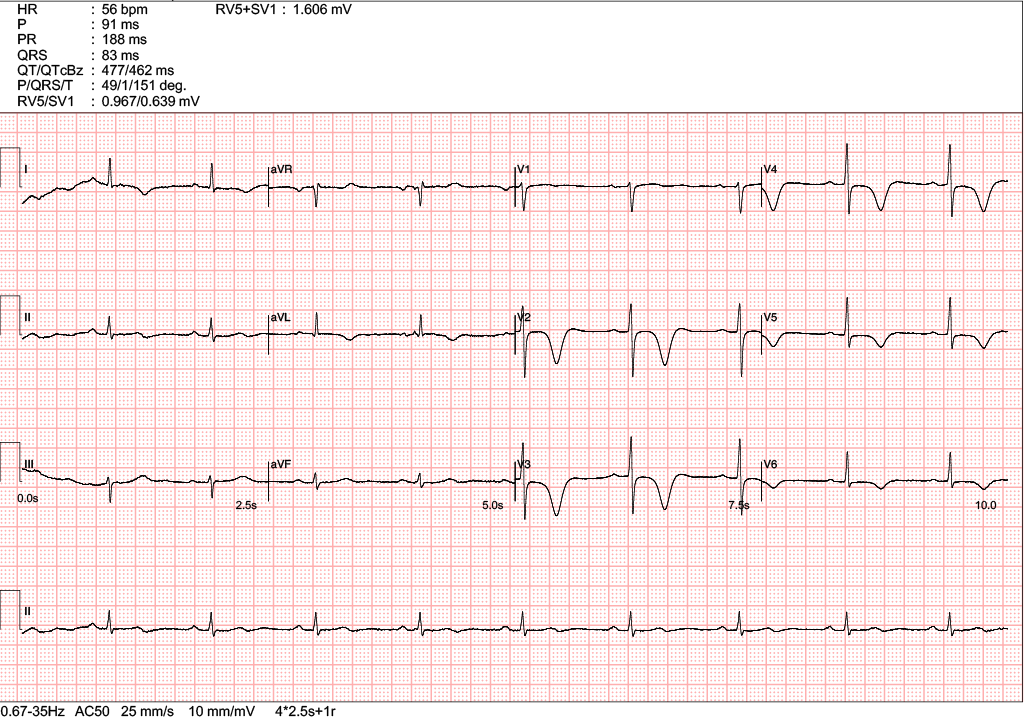
His presentation electrocardiogram (ECG) is shown below.
Which of the following statement is correct?
Choose the correct answer.
The correct answer is B. This is a case of Wellens' syndrome.
The clinical presentation (recent chest pain that has resolved) combined with deeply and symmetrically inverted T waves in the anterior precordial leads (V2–V4) describes Wellens’ syndrome Type B. This ECG pattern usually signifies recent reperfusion following a transient occlusion of the proximal left anterior descending (LAD) coronary artery. Despite current symptom resolution and potentially normal/borderline cardiac enzymes, the patient remains at an extremely high risk for recurrent occlusion and catastrophic anterior wall myocardial infarction.
Urgent or early invasive evaluation with percutaneous coronary intervention (PCI) is mandatory to revascularize the critical LAD stenosis, regardless of whether the patient is pain-free or troponin-negative at presentation.
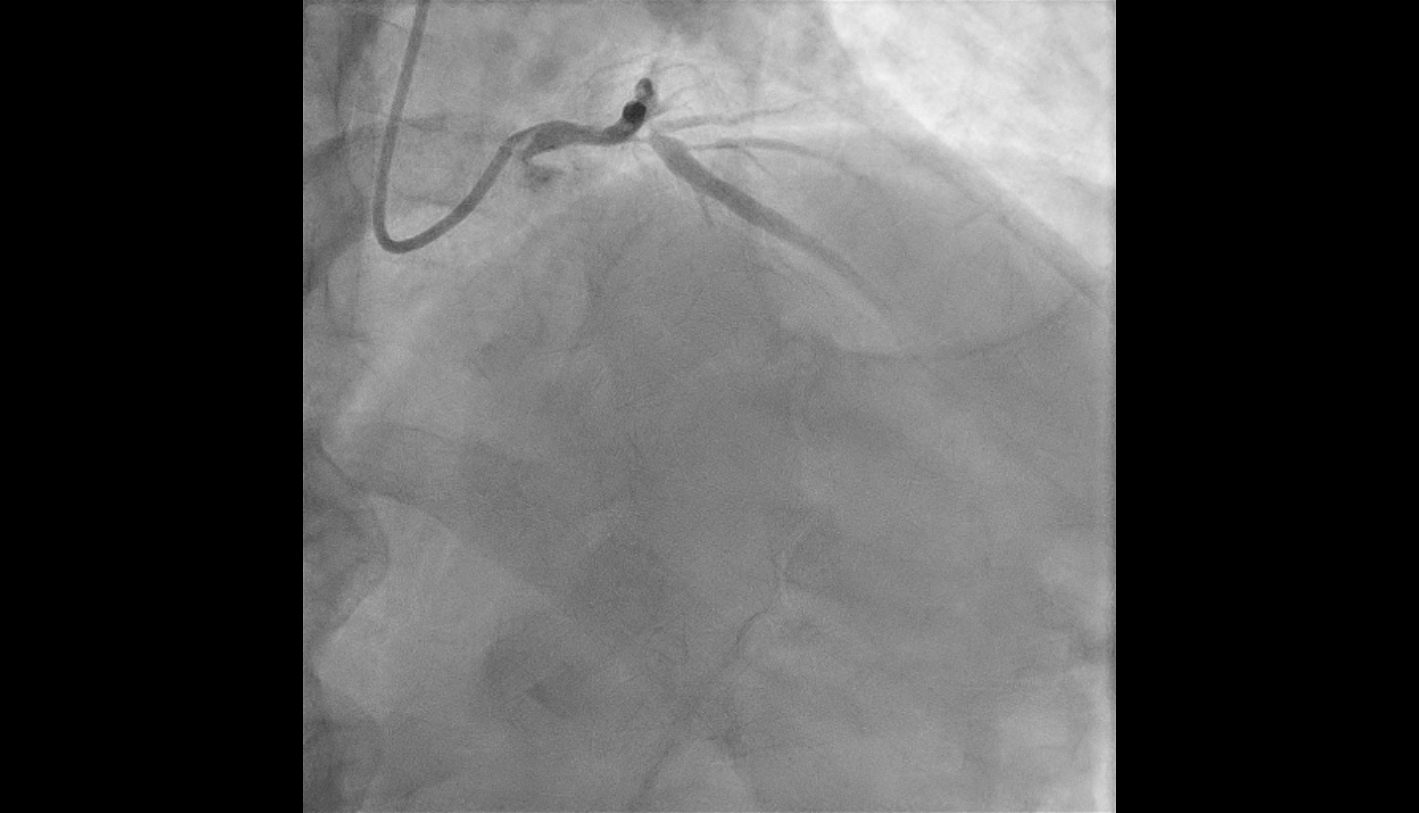
An urgent coronary angiogram was arranged, confirming subtotal occlusion of the proximal LAD as anticipated.
A is incorrect. Acute Coronary Syndrome (ACS) includes Unstable Angina (UA) as well as NSTEMI and STEMI. Serum cardiac troponin elevation with a dynamic rise and/or fall is required to fulfill the diagnostic criteria for Myocardial Infarction (MI), but not for ACS as a whole. Wellens’ syndrome often represents a form of unstable angina or evolving NSTEMI where troponins may be normal or only minimally elevated.
C is incorrect. On echocardiography, anterior wall motion is typically normal or near-normal when the patient is in the pain-free state. Because Wellens’ pattern appears during transient reperfusion, anterior wall segments typically regain function (stunned myocardium may quickly recover or remain preserved), rather than demonstrating persistent akinesis. Transient wall motion abnormalities are only seen during active ischemic pain.
D is incorrect. While pulmonary embolism (PE) can present with chest pain and right precordial T-wave inversions (V1–V3), several features argue strongly against PE in this scenario: the absence of dyspnea, the resolution of typical anginal pain, and the extension of T-wave inversions laterally to leads V4–V6 (well beyond V1–V3). Consequently, arranging a CTPA is unnecessary and risks delaying urgent cardiac catheterization.
E is incorrect. Wellens' syndrome is an NSTE-ACS / pre-infarction state. Administering thrombolysis in NSTE-ACS is not indicated.